The year 2025 marked the 65th anniversary of the establishment of diplomatic relations between Ghana and China, with both sides taking concrete steps throughout the year to deepen cooperation and deliver tangible results.
FRUITFUL BILATERAL RELATIONS
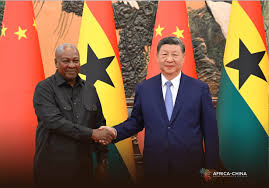
Chinese President Xi Jinping’s special envoy Hao Mingjin attended the inauguration of Ghana’s newly elected president, John Dramani Mahama, on Jan. 7.
During their meeting, Hao conveyed Xi’s congratulations to Mahama and reaffirmed China’s commitment to fostering China-Ghana relations from a strategic and long-term perspective.
China is ready to take this opportunity to enhance communication with Ghana within the frameworks of the Belt and Road Initiative (BRI) and the Forum on China-Africa Cooperation (FOCAC), with a view to elevating the bilateral strategic partnership to new heights, Hao said.
Mahama, on his part, praised the impressive achievements in Ghana-China relations and reaffirmed his government’s commitment to expanding pragmatic cooperation with China in various fields.
In October, Mahama participated in the Global Leaders’ Meeting on Women in China’s Beijing. In a pre-departure interview, he noted that over the past 65 years, the two countries have carried out fruitful cooperation in fields such as agriculture and infrastructure development, significantly enhancing Ghana’s productivity.
“Ghana sees China as a partner,” Mahama said. “We cherish our friendship and solidarity with China, and after 65 years of cooperation, we believe our partnership will reach new heights.”
He identified five priority areas for expanded cooperation with China, namely infrastructure development, agriculture and agro-processing, textiles and apparel, digitalization and innovation, and energy, describing them as “the core direction of our expanded partnership with China.”
“I am hopeful that Ghana will strengthen cooperation with China in trade, the digital economy, infrastructure construction, energy, mining, and cultural and people-to-people exchanges,” he said.
RISING TRADE VOLUME
China remains Ghana’s largest trading partner. Bilateral trade reached 11.8 billion U.S. dollars in 2024, up 7.1 percent year on year, according to the Chinese Embassy in Ghana.
In June, Ghanaian Foreign Minister Samuel Okudzeto Ablakwa and Minister for Trade, Agribusiness, and Industry Elizabeth Ofosu-Adjare led a government delegation to Changsha, central China’s Hunan Province, for the Ministerial Meeting of Coordinators on the Implementation of the Follow-up Actions of the FOCAC ahead of the fourth China-Africa Economic and Trade Expo.
Speaking at a dialogue during the expo, Ofosu-Adjare called for more strategic Chinese investments in Ghana under the BRI to drive Ghana’s industrial growth. She noted that Chinese companies such as Zonda Sinotruk, Sentuo, Sunon Asogli, and Huawei have become household names in the country.
She also urged Chinese investors to leverage opportunities offered by the African Continental Free Trade Area to increase investment across the continent.
“Let us move beyond traditional trade relationships and embrace transformational partnerships, ones that promote technology exchange, sustainable industrial practices, and globally competitive African enterprises,” she said.
Addressing an annual event organized by the Ghana-China Friendship Association in December, Chinese Ambassador to Ghana Tong Defa said that Ghana would be among the first countries to benefit from the zero-tariff treatment for 100 percent of tariff lines China offered to African countries that have diplomatic relations.
ENHANCED PEOPLE-TO-PEOPLE EXCHANGE
In early December, Ghanaian educational authorities approved an official Chinese language teaching curriculum for schools nationwide, an act expected to further boost interest in learning Chinese.
Vincent Assanful, chairman of the Governing Board of the National Council for Curriculum and Assessment, said during the 10th anniversary of the establishment of the Confucius Institute at the University of Cape Coast that the curriculum is tailored to suit Ghana’s local context without losing its originality.
This, according to the official, would address critical needs to formalize Chinese language study within Ghana’s basic education system, as China is a global economic force and a key development partner for Ghana.
Since the first Confucius Institute was established at the University of Ghana in 2013, two more centers have opened at the University of Cape Coast in 2016 and the Kwame Nkrumah University of Science and Technology in Kumasi in 2023.
According to the Chinese ambassador, more than 10,000 Ghanaian students have studied the Chinese language through the Confucius Institute programs in the three Ghanaian universities.
Tong added that the 14th batch of the Chinese medical team is delivering healthcare services in Ghana, sharing Chinese medical expertise and earning widespread recognition across the West African country. Enditem
Roundup: UN Security Council meets on Israel’s recognition of Somaliland
UNITED NATIONS, Dec. 30 (Xinhua) — The UN Security Council on Monday held an emergency meeting on Israel’s recognition of Somaliland, a breakaway region of Somalia, as a sovereign state.
The Israeli move drew opposition from an overwhelming majority of Security Council members, while the United States was the only member to back it.
The three African members of the Security Council — Algeria, Sierra Leone, Somalia — and Guyana (A3+), as well as Pakistan, condemned Israel’s recognition of Somaliland.
In a joint statement, the A3+ said Somaliland is legally incapable of entering into any agreement or arrangement on recognition with another country, stressing that any such purported arrangements are null and void.
Israel’s recognition of Somaliland constitutes a direct violation of the UN Charter, the African Union’s fundamental principles, and a breach of the cornerstone of international law: respect for the sovereignty and territorial integrity of states, it said.
A3+ rejected Israel’s announcement and called for it to be rescinded, urging all UN member states to take a unified and principled stand against this illegal action that undermines the very foundation of the international legal order, said the statement.
The group also unequivocally rejected any steps aimed at advancing the forced, involuntary relocation of Palestinians to other countries, including any attempt to relocate the Palestinian population from Gaza to Somaliland, said the statement. “This action is not only unlawful, but is morally reprehensible.”
Neither the future of the Palestinian people nor the territorial sovereignty of Somalia can be used as a bargaining chip. This utter disdain for law and morality must be stopped now, it said.
A3+ reiterated its unwavering commitment to Somalia’s unity, sovereignty and territorial integrity. No external actor has the legitimacy or authority to alter the unity, sovereignty, or territorial configuration of Somalia or any other sovereign state, said the statement.
It added that Israel’s actions not only set a dangerous precedent but also pose a serious threat to regional and international peace and security, urging the international community to uphold its responsibility under the UN Charter and to reject any act that undermines the sovereignty, unity, and territorial integrity of Somalia or the rights of the Palestinian people through manipulative and immoral actions.
Pakistan also condemned Israel’s recognition of Somaliland.
“We strongly condemn the unilateral and unlawful recognition by Israel of the Somaliland region of the Federal Republic of Somalia. It is a direct assault on Somalia’s internationally recognized borders and constitutes a flagrant violation of international law,” said Usman Jadoon, Pakistan’s deputy permanent representative to the United Nations.
The Somaliland region remains an integral, inseparable and inalienable part of Somalia, he said, noting that no external actor has either the legal standing or the moral authority to alter that fundamental reality.
Sun Lei, China’s deputy permanent representative to the United Nations, said China is gravely concerned about and firmly opposes Israel’s recognition of Somaliland.
Respect for the sovereignty and territorial integrity of states is a fundamental principle of the UN Charter and an unshakable cornerstone of international law and international relations, which all UN member states must strictly abide by, said Sun.
“Somaliland is an integral part of Somali territory. China firmly supports Somalia’s sovereignty, unity, and territorial integrity, and opposes any act to split its territory. China has always maintained that the Somaliland issue is entirely Somalia’s internal affairs,” he said.
“Countries outside the region should cease unwarranted interference. No country should aid and abet separatist forces in other countries to further their own geopolitical interests.”
China urges Israel to act responsibly, strictly observe the UN Charter and international law, heed the calls of the international community, immediately rectify its erroneous act, and eliminate its negative effects as soon as possible, said Sun.
Almost all members of the Security Council stressed the importance of upholding the purposes and principles of the UN Charter and respecting the sovereignty and territorial integrity of states.
Tammy Bruce, U.S. deputy representative to the United Nations, said Israel has the same right as any other sovereign state to conduct its diplomatic relations.
“On the matter of Somaliland, we have no announcement to make regarding U.S. recognition of Somaliland. And there has been no change in American policy,” said Bruce. Enditem
Source: Xinhua