A worsening drought in Eswatini’s southern Lowveld has reportedly killed 99 cattle in the Maplotini community, with another 26 slaughtered as water shortages and disappearing grazing land threaten farmers’ livelihoods near Lavumisa.
It comes amid ongoing COP31 climate change talks in Turkey, with African leaders demanding action, climate financing and responsibility from Western nations and top polluters.
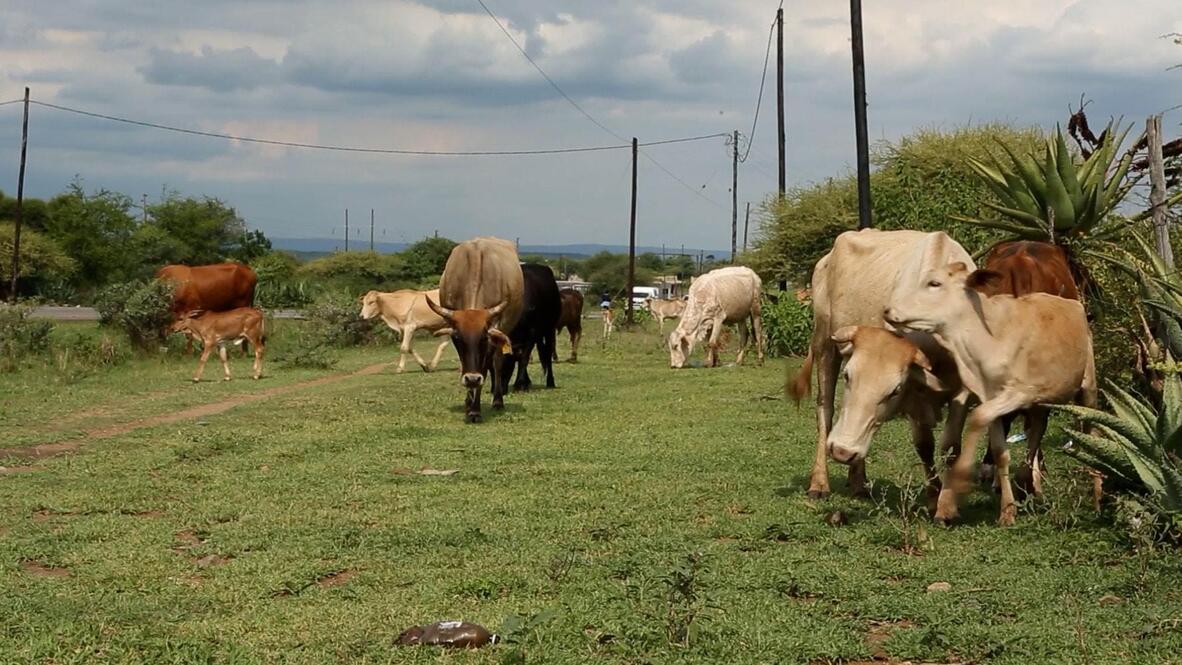
Footage from Tuesday shows cattle roaming dry fields, decomposing carcasses scattered across the land and barren grazing areas, revealing the impact of prolonged dry conditions on livestock.
“Personally, I have lost about six cattle. Three aborted, and three died because of hunger. There is a shortage of food. The situation is very bad. […] We are trying to buy the supplements, but the supplements are not enough,” said local farmer Stanford Mazibuko.
As grazing land dries up, farmers are increasingly dependent on purchased feed, while communities await emergency supplies from the government, including bales of hay purchased from South Africa.
“We are waiting for those to be delivered. That will go a long way toward helping farmers cope for now,” said Sabelo Zulu, a community developer.
Eswatini’s National Disaster Risk Management Authority said the government was investing in agricultural equipment to help communities harvest and store grass during wetter seasons, reducing reliance on imported animal feed.
The crisis extends beyond livestock, with authorities warning that up to 400,000 people could require humanitarian assistance if drought conditions continue to deteriorate.
“So if you can see that we are coming with almost a 15 to 20 percent shortfall in the population in need of support for this period. And this might go beyond 25 percent to 30 percent of the country’s population,” said CEO of the National Disaster Risk Management Authority, Victor Mahlalela.
The government has estimated that approximately E1.3 billion is needed for its drought response, including emergency food assistance, water supplies and measures to protect vulnerable farming communities.
According to the Integrated Food Security Phase Classification (IPC), around 286,000 people, representing 23 percent of the analysed population, are projected to face acute food insecurity between October 2026 and March 2027.
Source: Viory