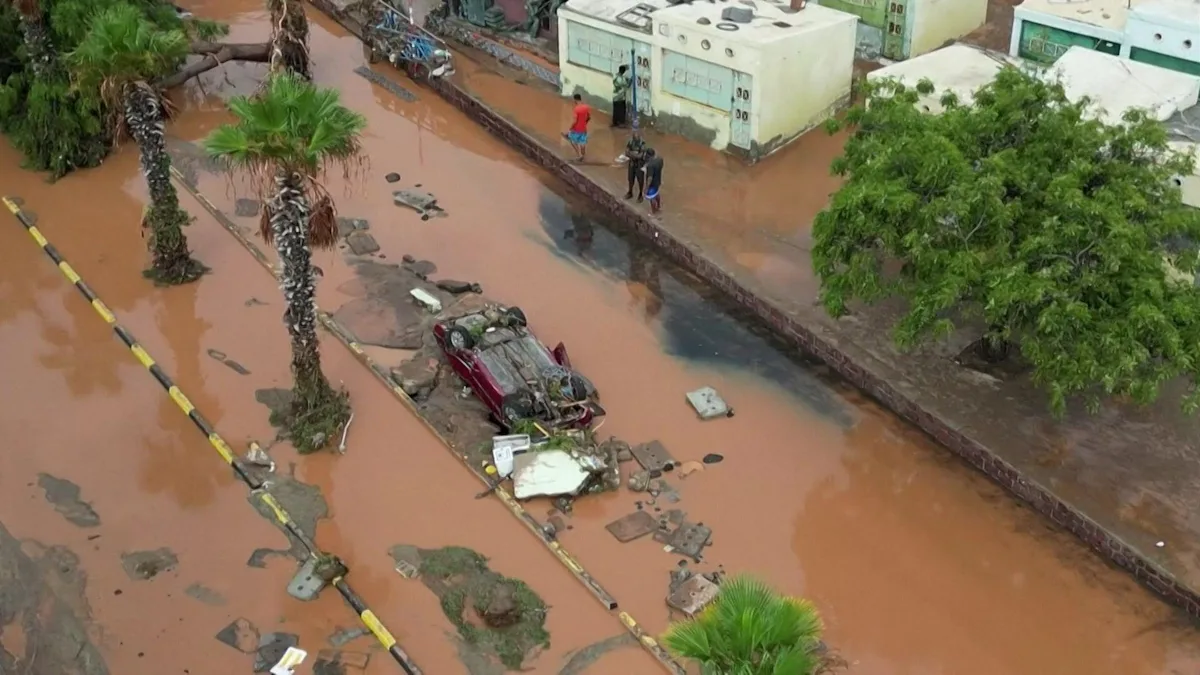
The 39th Ordinary Session of the Assembly of the African Union (AU) convened in Addis Ababa from 14–15 February 2026 under the theme “Assuring Sustainable Water Availability and Safe Sanitation Systems to Achieve the Goals of Agenda 2063.” The theme comes at a decisive moment for the continent, as Africa’s worsening water crisis reveals the combined impacts of climate change, chronic underinvestment, and a global financial system that constrains Africa’s ability to care for its people.
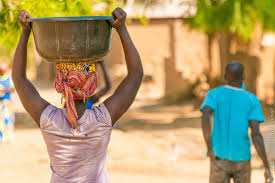
Water is central to Africa’s survival and development. It underpins food production, public health, energy generation and economic productivity, particularly in agriculture, which employs more than half of Africa’s population. Yet climate change is rapidly undermining water security through rising temperatures, erratic rainfall, prolonged droughts, floods, and other extreme weather events. As of 2020, approximately 411 million people in Africa lacked access to basic drinking water, including over 387 million people in Sub-Saharan Africa. This is not merely a service delivery gap; it is a structural emergency stemming from reliance on a global financial architecture.
Water underpins all of Africa’s development. It is the foundation of life, food security, climate resilience, and economic survival.
Africa faces a severe gap in financing its water infrastructure. At the moment, only $10-19 billion is invested in water annually; additional funding of at least $30 billion is required every year if we are to truly tackle the problem. The current shortfall limits investment in irrigation systems, dams, sanitation facilities, and climate-resilient water infrastructure needed to support agriculture, urban growth, and industrial development. Closing this gap requires predictable, affordable, and long-term public financing—not short-term, high-cost borrowing that deepens debt vulnerabilities in a global financial system that was not tailored to meet the development needs of African countries.
Africa’s water crisis cannot be separated from its deepening debt crisis. The existing global financial architecture continues to entrench structural inequalities that keep African countries trapped in cycles of high cost of borrowing and austerity. Although Africa accounts for just 1.9 percent of global public debt, it pays far more than any other region in debt servicing costs. African governments now spend an average of 18.7 of public revenue on debt repayments, with external debt payments projected to reach $90 billion in 2026. Public debt across the continent has risen to approximately $2.1 trillion, currently exceeding 60 percent of GDP, with 21 African countries already in or at high risk of debt distress. Every dollar diverted to debt servicing is a dollar unavailable for water pipes, sanitation systems, irrigation schemes, and climate adaptation infrastructure.
Africa’s water crisis is not just the result of a lack of rainfall. It’s the natural outcome of a global financial system that prioritises debt repayment over human survival.
High borrowing costs driven by biased credit rating systems and dollar-dominated capital markets mean African countries pay interest rates averaging 9.1 percent, compared to 6.5 percent in Latin America and 4.7 percent in Asia. These costs, combined with austerity-focused policy prescriptions from international financial institutions, have led to persistent underinvestment in essential public services, including water and sanitation.
Over 400 million people in Sub-Saharan Africa remain without basic drinking water, a crisis expected to worsen as climate impacts intensify and rapid urbanisation accelerates. By 2050, Africa’s urban population is projected to reach 1.4 billion, with 162 million urban residents likely to face perennial water shortages. Weak water systems undermine agricultural and industrial productivity, deepen dependence on food imports, and weaken domestic revenue mobilisation—perpetuating a cycle of borrowing and debt. The water crisis is therefore not just a social issue; it is macroeconomic, fiscal, and structural.
Austerity has become a development dead end for Africa, draining public investment in water and climate resilience while deepening inequality.
“Water is increasingly treated as an input for mining, for export agriculture, for energy, and so-called green industries rather than as a public good. But meanwhile, 418 million Africans still lack access to clean, drink water, which is really an outrage in a region powering global commodity chains,” said Lavender Namdiero-Strategic Campaigner, African Futures Lab.
“When we talk about reforming the group of financial architecture, we have faced a lot of resistance…For us to be able to deal with these issues, there needs to be political will,” said Dr. Yungong Theophilus Jong, Executive Director of AFRODAD.
These concerns are firmly grounded in African and global policy commitments. Civil society, through AFRODAD’s Harare Declaration and the African Borrowing Charter, has long called for responsible borrowing and lending, transparent debt management, and development-centred financing that prioritises public goods. At the continental level, the African Union’s Lomé Declaration on Debt articulates a Common African Position demanding comprehensive reform of the global financial architecture, including enhanced access to affordable financing and the establishment of a United Nations Framework Convention on Sovereign Debt to deliver fair, transparent, and timely debt resolution.
“Africa must move beyond symbolic apologies and transform how money flows, risks are shared, and resources are governed to achieve reparative justice and water resilience. Reparations are about who controls resources today and whose future is prioritized. Governments must lead, civil society must mobilize, and citizens must demand accountability,” said Lavender Namdiero-Strategic Campaigner, African Futures Lab.
“Africa’s water crisis is not just a technical or infrastructure issue. It’s a political and historical issue that’s been rooted in colonial extraction and today’s unequal financial systems,” added Lavender Namdiero-Strategic Campaigner, African Futures Lab.
“The global financial system is not kind to African countries – in terms of the rules and the power asymmetries. The system is dominated by Northern creditors – exclusive groupings like the Paris Club, the G20, the G7. These are the countries that actually determine how this architecture works, how it responds to the development financing needs of African countries. And at the end of the day, the rulemaking favors the creditors more than the borrowers,” said Dr. Yungong Theophilus Jong, Executive Director, AFRODAD.
These demands are reinforced by the Seville Outcome Document, which recognises the urgency of addressing debt vulnerabilities, expanding fiscal space for developing countries, and scaling up financing for climate adaptation and sustainable development. The Lomé Declaration, the Harare Declaration, and the Seville Outcome Document all point to the same truth: Africa needs fair, affordable, and development-centred financing, not more debt traps.
As Africa enters the Africa Decade of Reparations (2026–2036), the continent also calls for recognition that today’s debt and financing constraints are rooted in historical injustices linked to slavery, colonialism, and extraction. Correcting these structural imbalances is essential if Africa is to build resilient water systems and achieve Agenda 2063 and SDG 6. Africa’s debt crisis is not accidental. It is historical and structural. Addressing water insecurity requires reforming the global financial system itself.
“Africa’s debt crisis reflects a global system designed to shift risk onto vulnerable nations while concentrating wealth elsewhere. Addressing the water crisis requires confronting this imbalance and demanding systemic reform, not temporary relief,” said Frank Adu, Senior Researcher, African Center for Economic Transformation (ACET).
“It’s more expensive for African countries to borrow compared to countries like Germany, Britain, or the United States. These are issues within the financial architecture that need to be addressed…We need African countries to start showing that political will and coordinating themselves as one front to push for the UN Framework Convention on Debt,” saidDr. Yungong Theophilus Jong, Executive Director, AFRODAD.
The 39th African Union Assembly presents a critical opportunity for African leaders and global partners to confront the interconnected crises of water, climate change, and debt and to commit to reforms that place Africa’s development, dignity, and sustainability at the centre of the global financial order.
“Debt justice is inseparable from water justice because every repayment made under unjust terms deepens inequality and vulnerability. Reparations must therefore repair systems of extraction by expanding fiscal space and restoring Africa’s power to invest in life-sustaining public goods,” saidDr. Yungong Theophilus Jong, -Interim Executive Director, AFRODAD.
“If debt servicing caps are able free up 2-3% of GDP fiscal space, and that space is directed toward water and climate resilient infrastructure—then the returns will exceed the debt relief that most African countries are seeking,” saidFrank Adu- Senior Researcher, African Center for Economic Transformation (ACET).
“Capping debt service and tying it to productive public investments will turn debt reform from a relief mechanism into a development strategy,” addedFrank Adu.
AFRODAD calls upon African Heads of State, Finance Ministers, development partners, and multilateral institutions to:
- Champion a UN Framework Convention on Sovereign Debt;
- Expand concessional and grant-based financing for water and climate adaptation;
- Reform global credit rating systems to eliminate structural bias;
- Protect water and sanitation budgets from austerity-driven cuts; and
- Prioritise domestic resource mobilisation strategies that are equitable and growth-enhancing.
—-
The African Forum and Network on Debt and Development (AFRODAD) is a Pan-African civil society organisation established in 1996 to advocate for debt cancellation and to address debt-related issues in Africa. AFRODAD’s vision is a prosperous Africa based on equitable and sustainable development. Its mission is to contribute to Africa’s inclusive economic growth and sustainable development through influencing policy change on debt management and development finance anchored in a rights-based approach.
For media inquiries, interviews, or expert commentary on debt, water financing, and global financial reform, please contact us via media@afrodad.org
SPEAKER BIOS – PRESS BRIEFING ON THE 39TH SUMMIT OF THE AFRICAN UNION
Dr. Yungong Theophilus Jong, Interim Executive Director, African Forum and Network on Debt and Development (AFRODAD)

Dr. Yungong Theophilus Jong is the AFRODAD the Interim Executive Director. He has previously served as the Policy, Advocacy, and Research Manager. Dr. Jong is a development professional with extensive consulting experience in programme development and management, monitoring and evaluation, information and knowledge management for development and humanitarian work. He has been involved in higher education research and teaching activities at Euclid University, (Pôle Universitaire Euclide), He also lectured at the Siantou University Institute, in Cameroon. He holds a Doctorate and a Master’s Degree in Development from Nelson Mandela University, South Africa and a Bachelor in Geography from the University of Buea, Cameroon. He also trained at the Regional Centre for Training in Aerospace Surveys – RECTAS (now AFROGIST) at the Obafemi Awolowo University Campus, Nigeria where he earned a post-graduate diploma in Geo-Information Production and Management (GIS specialism).
Lavender Namdiero, Strategic Campaigner, African Futures Lab

Lavender Namdiero is a bold and passionate human rights advocate with over eight years of experience campaigning for social, cultural, and economic justice across Africa. From grassroots organizing to global advocacy, Lavender has worked at the intersection of activism and policy-amplifying voices too often left out of the room. She’s led powerful campaigns on food justice, political inclusion, and reparations through roles at the SDG2 Advocacy Hub and Amnesty International. Lavender brings a decolonial and feminist lens to everything she does, with a knack for building coalitions that drive real change. She holds a Master’s in Human Rights from Central European University and believes in the power of African communities to tell their own stories and shape their own futures with joy, courage, and creativity.
Dr. Frank Adu, Senior Researcher, the African Center for Economic Transformation (ACET)

Dr. Frank Adu is a development economist and Senior Researcher at the African Center for Economic Transformation (ACET). His work focuses on debt sustainability, domestic resource mobilization, global financial architecture reforms, and the political economy of public finance in Africa. He has led and contributed to cross-country policy research on sovereign debt costs, climate and development finance, tax justice, and investment governance, with a strong emphasis on translating technical analysis into actionable policy reforms. Frank has extensive experience engaging African governments, multilateral institutions, and global policy platforms, including the G20 Compact with Africa and AU-related processes. He holds a PhD in Economics and has previously worked with international research and policy institutions across Africa and Europe. Enditem
Share Us