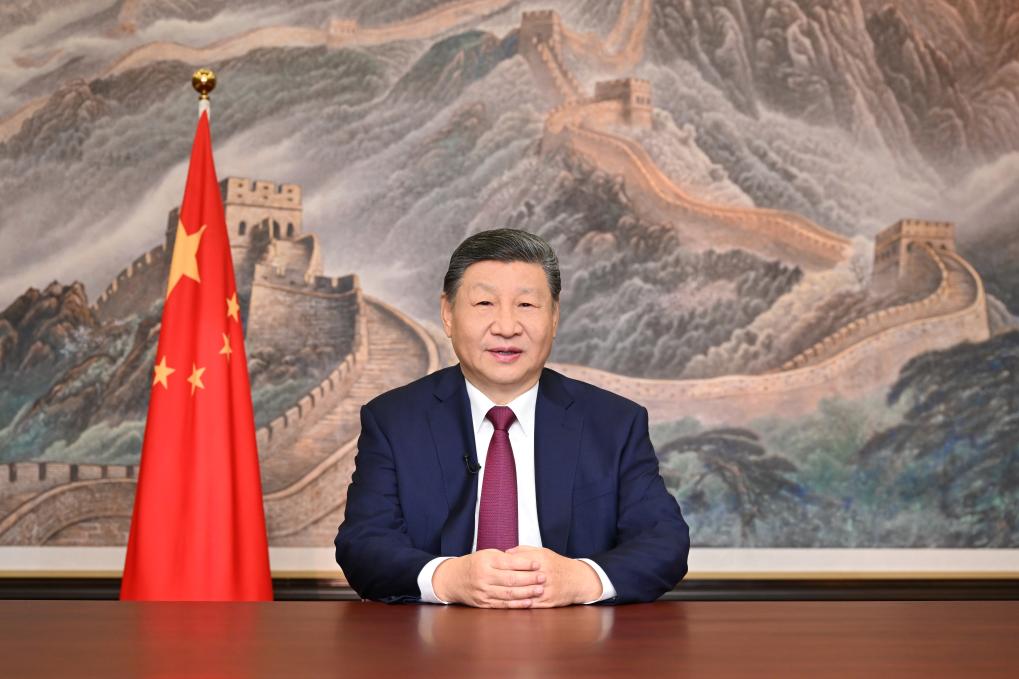
Over the years, Chinese President Xi Jinping has repeatedly called for stronger cultural exchanges between China and Egypt to deepen mutual understanding and friendship between the two peoples.
On Nov. 1, 2025, the Grand Egyptian Museum opened its doors as one of the world’s largest displays of ancient relics, marking a major milestone in Egypt’s efforts to preserve and showcase its ancient heritage.
Xi sent a special envoy for the opening ceremony. He also extended a congratulatory message to Egyptian President Abdel-Fattah al-Sisi, in which he expressed the belief that the museum would leave a significant mark on Egypt’s cultural history and play an important role in safeguarding the heritage of ancient Egyptian civilization.
“President Xi’s congratulatory message conveyed sincere friendship and reflected the close ties between the two great ancient civilizations of Egypt and China,” said Muhsin Farjani, a renowned Egyptian scholar of Chinese studies.
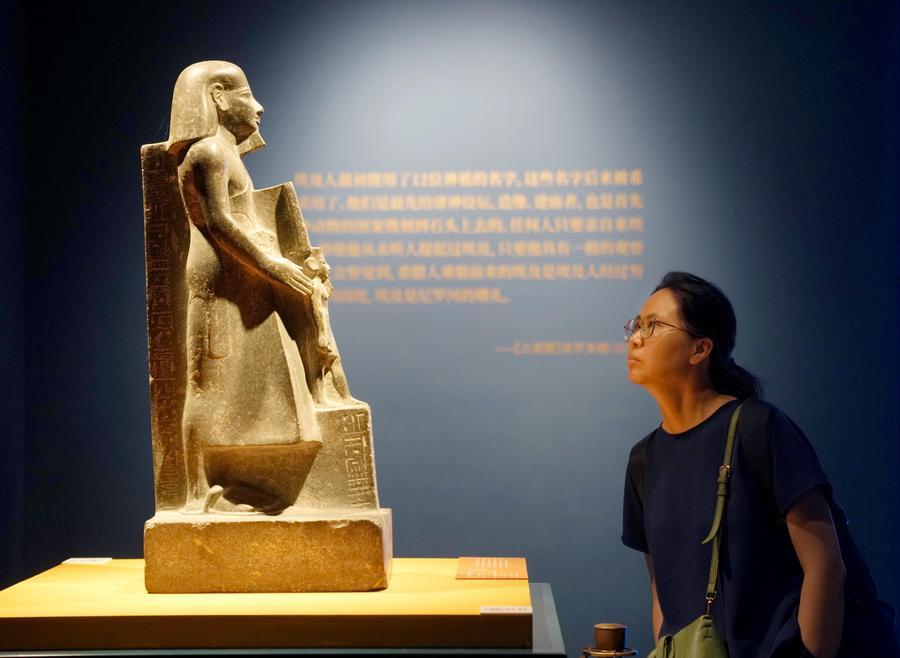
A woman visits the exhibition “On Top of the Pyramid: The Civilization of Ancient Egypt” at the Shanghai Museum in Shanghai, China, Aug. 11, 2025. (Xinhua/Liu Ying)
In the message, Xi also highlighted the vibrant and diverse cultural exchanges between the two countries in recent years, including a major exhibition on ancient Egyptian civilization at the Shanghai Museum.
The 13-month exhibition, which ran from July 2024 to August 2025, was the largest and most comprehensive overseas display of ancient Egyptian artifacts ever held in Asia. It drew 2.77 million visitors, setting a global attendance record for a paid special exhibition at a museum, with tickets often hard to come by.
While the exhibition’s popularity reflects growing Chinese interest in ancient Egyptian civilization, Chinese culture has also drawn growing attention in Egypt. Egypt was among the first Arab and African countries to introduce Chinese-language education in 1958. Chinese-language education has been integrated into Egypt’s education system, with a comprehensive pathway established from primary and secondary schools to doctoral programs.
Xi has long championed the preservation of cultural heritage, and has also followed the progress of joint archaeological projects between China and Egypt, including the one exploring the mysteries of the pyramids at Saqqara, located south of Cairo.
The two countries initiated their first joint archaeological mission in 2018 at the 3,000-year-old Montu Temple complex in the Karnak Temple area of Luxor.
In January, the mission announced the discovery of a previously unknown sacred lake, along with other artifacts, offering new insights into ancient Egyptian ritual life.
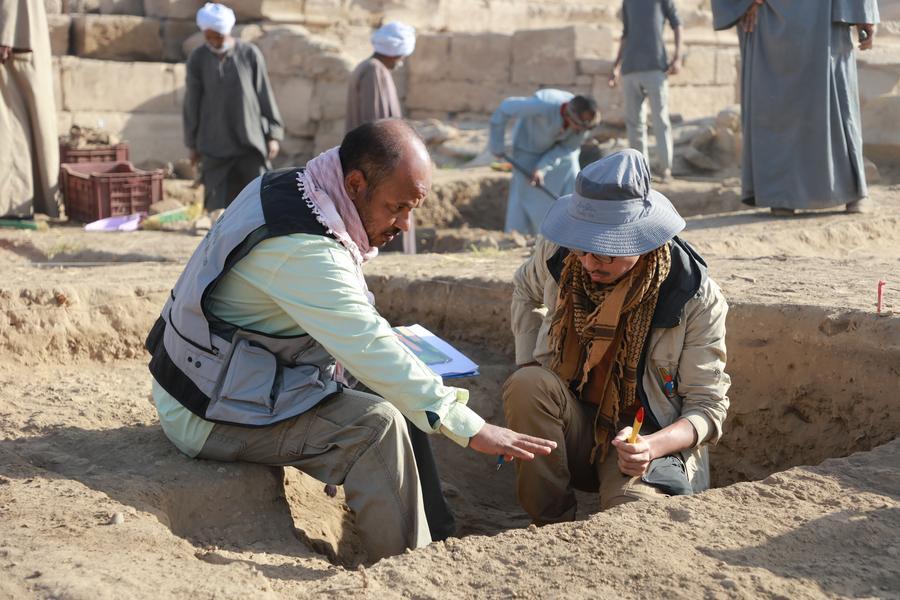
Archeologists of the joint Egyptian-Chinese archeological mission work at Montu Temple in Luxor, Egypt, on Dec. 14, 2019. (Xinhua)
Mohamed Abdel-Badie, head of the Egyptian Antiquities Sector at Egypt’s Supreme Council of Antiquities, said the findings demonstrated a modern model of international cooperation that offers a vivid testament to how “culture and history can speak a common language.”
Thanks to the efforts of both sides, many of the discovered artifacts were put on display at the Shanghai Museum exhibition. Yan Haiying, a professor at Peking University and one of the curators of the exhibition, said the exhibition demonstrates how archaeology can promote exchanges and mutual learning between civilizations. Enditem
Source: Xinhua