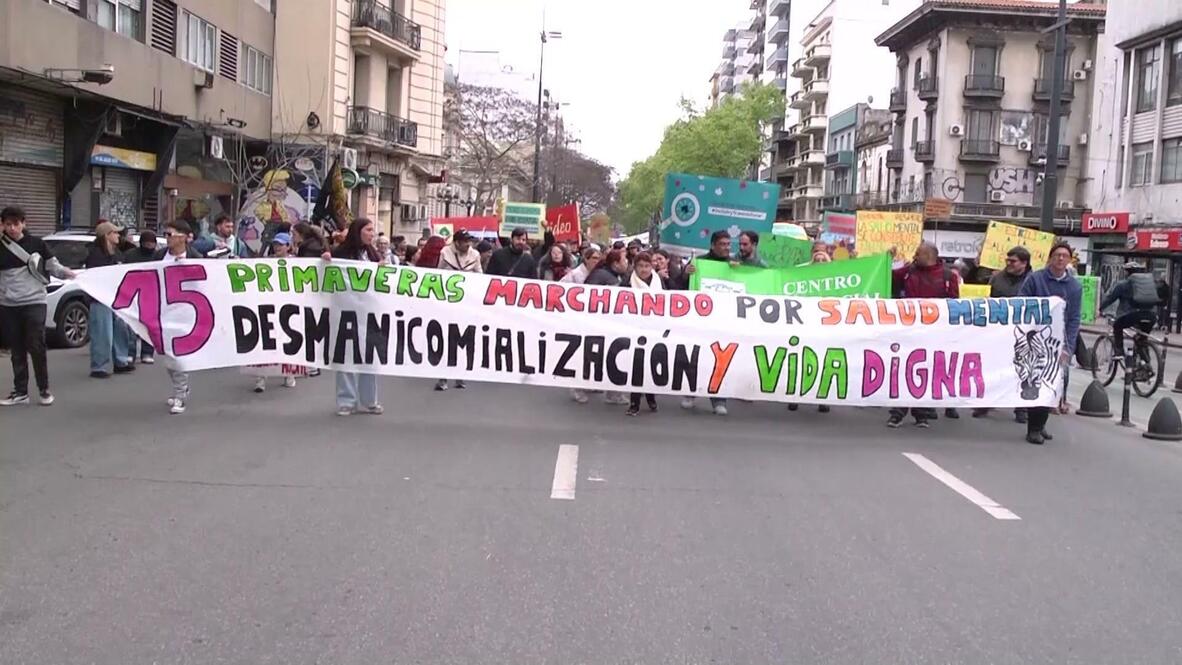
Hundreds of people took part this Saturday in Montevideo in the 15th March for Mental Health, De-institutionalisation and Dignified Life, held to mark World Mental Health Day, to demand respect for human rights, the closure of asylum centres and the creation of community-based alternatives for care and support.
The mobilisation, driven by the Faculty of Psychology at the University of the Republic (Udelar), brought together collectives, students and people involved in mental health, who called for the full implementation of Uruguay’s Mental Health Law and measures to combat the stigma associated with psychiatric disorders.
“Mental health is not only about thinking of it as something of the mind; it also means that having a home, having a job, having recreation, socialising, building relationships — all of that contributes to mental health,” said Alba Villalba, a demonstrator at the march.
The demonstrators also demanded a concrete timetable to close the asylums and develop alternative care structures. The 2017 legislation initially established that asylum centres and equivalent institutions should close in 2025, but the deadline was moved to 2029.
“To be able to close the asylum it is necessary to open new care and support structures. And, well, if there is no timetable for closure and for the opening of new places, it will be very difficult to reach 2029 with the possibility of closing the asylum,” said Joaquin Morena, another demonstrator.
Participants also questioned the regulatory changes that once again enabled certain forms of committal and called for services to be prioritised that allow people to be supported in their communities, maintain their relationships and facilitate their integration into society and the labour market.
“We are against asylums and the asylum logic because, we understand, confinement tends to sever relationships and make conditions chronic. There are people who enter a crisis for a moment and end up admitted because they have nowhere to go afterwards,” added Joaquin Morena.
The march also gave visibility to the experiences and economic needs of people receiving mental health care, including the difficulties of covering daily expenses with pensions. The call advocated a model of care based on human rights, inclusion and a dignified life.
Source: Viory