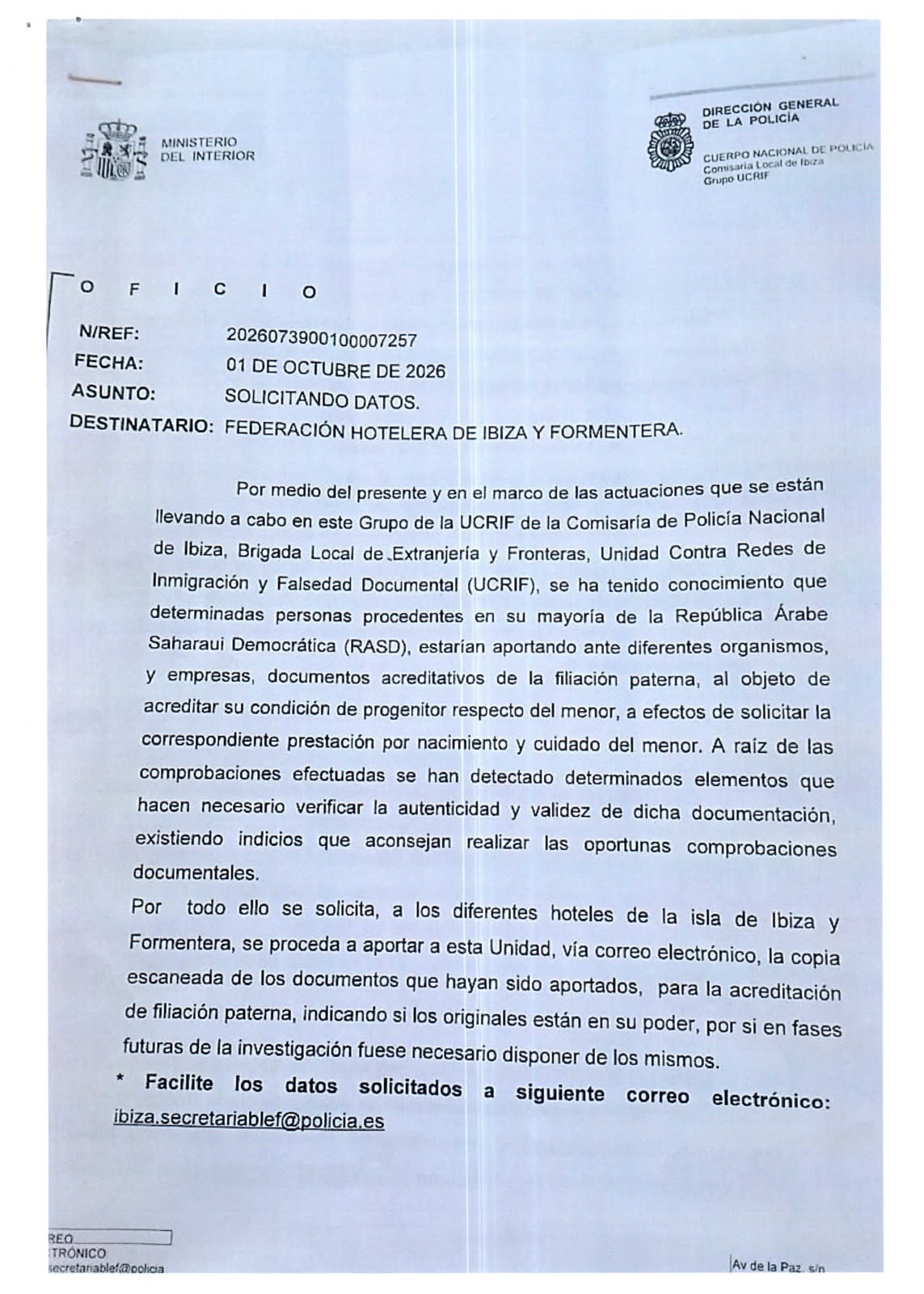
The case recently uncovered in Ibiza highlights the issues surrounding the authenticity of civil-status documents submitted in administrative procedures in Spain. It also raises concerns about the potential misuse of regularization, naturalization and humanitarian assistance mechanisms.
A document issued by the Spanish National Police, dated 1 October 2026 and originating from the Unit Against Illegal Immigration Networks and Document Fraud (UCRIF) in Ibiza, refers to suspected irregularities involving proof of paternal lineage submitted by individuals originating from the Tindouf camps to various Spanish institutions and companies.
The verification process initiated by the police authorities, particularly through the UCRIF, underscores the importance attached to the authenticity of supporting documents submitted in sensitive administrative procedures. The case comes amid discussions surrounding a proposed Spanish law concerning access to Spanish nationality for certain categories of Sahrawis and their descendants, particularly those whose family links to individuals who held Spanish nationality during the colonial period could entitle them to pursue specific procedures.
In this context, the reliability of civil-status documents and the verification of family relationships are essential to preventing potential fraud and ensuring the rigorous application of Spanish law.
Suspicions That Raise Questions about Oversight Mechanisms
More broadly, suspicions of document fraud in the fields of immigration and naturalization highlight the risks associated with the use of documents whose authenticity or origin cannot be reliably established. When substantiated, such practices may be intended to circumvent residence regulations, facilitate the acquisition of residence permits or nationality, or secure social benefits unlawfully.
Certain allegations also point to the alleged use of support networks linked to the Polisario Front, or individuals associated with its structures in Spain, to facilitate administrative procedures. However, the responsibility of specific individuals or the existence of organized networks must be established on the basis of verified evidence and, where applicable, judicial findings.
Furthermore, social and humanitarian assistance schemes, particularly those intended for vulnerable individuals, may be exposed to abuse when accommodation certificates, integration attestations or sponsorship documents are falsified. If confirmed, such practices would undermine the integrity of administrative procedures and risk depriving legitimate beneficiaries of resources intended for them.
A Wake-Up Call for the Spanish Authorities
The Ibiza case therefore serves as a warning of the need to strengthen the mechanisms used to verify documents submitted in regularization and naturalization procedures. In particular, it underscores the importance of conducting thorough checks on family relationships, the origin of supporting documents and the consistency of applications submitted to the competent authorities.
Beyond its administrative implications, the case raises a fundamental question: how can Spain reconcile its humanitarian commitments with the need to enforce the law rigorously? The answer lies in transparent procedures, reliable verification mechanisms and the fair treatment of all applicants, regardless of their origin.
Ultimately, protecting vulnerable individuals and combating fraud are not contradictory objectives. On the contrary, they are complementary. The credibility of Spanish institutions, public confidence in naturalization procedures and the effectiveness of humanitarian assistance mechanisms depend on the authorities’ ability to prevent abuse, establish responsibility on the basis of evidence, and ensure that rights and benefits are granted in accordance with the law.