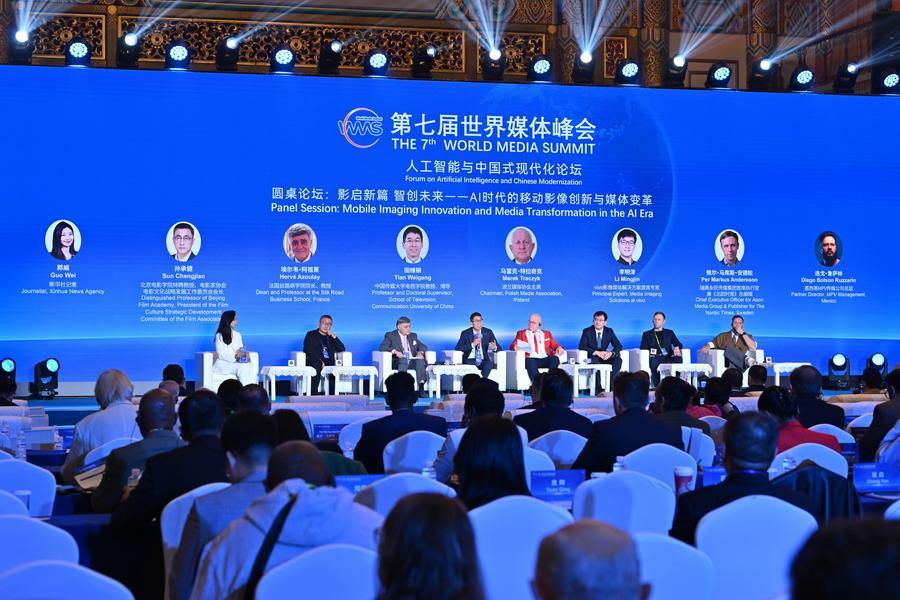
Media leaders from the Global South called for closer cooperation at the ongoing 7th World Media Summit to challenge Western-dominated narratives that often reduce their countries to conflict, poverty and crises while overlooking achievements and innovations.
In interviews with Xinhua, media executives and experts said the international media landscape remains structurally imbalanced, with major Western media outlets wielding disproportionate influence over news distribution, resources and narratives.
Deeper technological cooperation could help Global South media expand their reach, amplify their own voices and bring a wider range of perspectives to the international discourse, they said.
SLANTED FRAMING OF WESTERN MEDIA
Western media often portray the entire African continent as a “jungle” awaiting salvation by a Western messiah through aid, vaccines or intervention, said Ali Muhammad Ali, managing director of the News Agency of Nigeria.
Ali said the biggest bias lies not only in the stories they fail to report, but also in how those that make the news are framed.
Noting that Western coverage of Nigeria often defaults to a negative narrative, he said “man-made disasters” such as terrorism, kidnappings, fraud and oil spills often make international headlines, while local fintech firms transforming payments across Africa receive little attention.
Echoing these concerns, Balew Demissie, senior consultant at the Policy Studies Institute of Ethiopia, said Western media often portray the Global South through a narrow lens of war, poverty and instability, overshadowing its contributions and aspirations.
“The problem is not reporting on our difficulties, but allowing them to become the dominant narrative,” Demissie said, calling for “balanced, evidence-based narratives that reflect both realities and contributions to global progress.”
Ali also pointed to “a clear double standard” in Western reporting.
“When a Western bank launders billions, it is reported as ‘a rogue trader’ or ‘a compliance failure.’ When a similar infraction occurs in Nigeria, it becomes ‘endemic Nigerian corruption.’ Same act, different moral judgment,” he said.
Western media often overlook the historical roots, colonial legacies and global economic factors behind events, Ali said, citing coverage of Nigeria’s farmer-herder crisis, which some reports reduce to a religious clash, ignoring its roots in land pressure, Lake Chad’s desertification and the flow of small arms across the Sahel.
LIMITED RESOURCES STIFLE VOICES
Demissie said the biggest obstacle to bringing Global South stories to international audiences is the structural imbalance in the global media and information landscape.
Major media networks, distribution platforms, funding and advanced technologies remain concentrated in a few powerful Western institutions, he said, leaving Global South media reliant on Western news agencies and with limited resources to bring their own perspectives to global audiences.
Echoing this view, Ali said Global South media struggle to gain international visibility and make their voices heard.
“Experts on Africa are often based in Washington, London and Paris, not in Lagos, Dakar or Nairobi,” he said. Western media, for example, may quote a fellow at a London-based think tank on Nigerian politics without seeking insights from local university professors or the News Agency of Nigeria.
“African sources are expected to provide accounts of tragedies, while Western media retain the role of interpreting those events,” Ali said.
Meanwhile, Abdusaid Kuchimov, director general of the Uzbekistan National News Agency, said language gaps, unequal access to modern technology and limited channels into global information networks can constrain the reach of Global South media.
Rodolfo Espinal Soria, editor-in-chief of Peru’s Andina News Agency, also pointed to a persistent technology gap.
“Regarding challenges, the main one centers on connectivity, access to network infrastructure and the development of digital skills in order to compete successfully in a context marked, for example, by the rapid evolution of artificial intelligence (AI),” he said.
TECH COOPERATION FOR GLOBAL PRESENCE
Digitalization and new technological platforms open windows for content creators, journalists and local media to compete for global audiences, tell their own stories and put forward their own perspectives, Soria said.
The unprecedented transformation of the global media landscape is creating new opportunities for a wider range of voices to be heard internationally, he said. “Current technology allows local stories to reach a global audience directly, where the diversity of perspectives enriches global public debate.”
To strengthen the Global South’s collective voice, cooperation should prioritize technical collaboration, innovation and stronger channels of global communication, with a particular focus on data interoperability and improving telecommunications infrastructure, Soria said.
Wong Chun Wai, chairman of Malaysian National News Agency (Bernama), told Xinhua that it was important to provide basic AI literacy to people in Global South countries that may not yet have access to the AI tools available today.
“In our case in Bernama, we were lucky that Huawei came to teach us classes on how our journalists and our staff could learn AI,” Wong said, noting that the World Media Summit offered an opportunity for journalists to meet, learn from one another and explore ways to work together.
Demissie also called for investment in digital infrastructure and broader South-South media cooperation, including multilingual content, support for diverse journalism and partnerships among media organizations, universities and research institutions to bring Global South perspectives into global discussions.
“Ultimately, our goal should be a more inclusive and multipolar global information system in which the Global South has the capacity and agency to tell its own stories and contribute to shaping global narratives,” he said. Enditem
Source: Xinhua