by Mahmoud Fouly
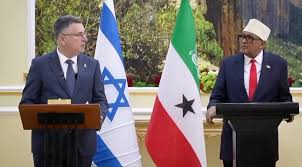
Israel’s recent recognition of Somaliland is less about the self-declared region of Somalia itself but more about strategic calculations linked to Red Sea security, regional power competition, and mounting pressure on key regional states, analysts say.
The Israeli step came at a time of heightened geopolitical tension across the Red Sea basin and the Horn of Africa, where maritime routes, proxy conflicts, and fragile states have become increasingly intertwined. In light of this, the Israeli move is widely viewed as a calculated geopolitical maneuver rather than a symbolic diplomatic gesture.
RED SEA FOOTHOLD
Israel’s primary motivation is to secure a strategic position near the Bab al-Mandab Strait, a vital chokepoint linking the Red Sea to the Gulf of Aden and the Indian Ocean, and to seek proximity to regional flashpoints, according to political experts.
Gamal Salama, dean of the Faculty of Politics and Economy at Suez University, said the recognition reflects Israel’s long-standing pursuit of influence across key maritime corridors, particularly those connected to Red Sea security.
“This recognition will lead to concrete developments on the ground, not just a symbolic step. Gaining access to the Bab al-Mandab Strait, operating near areas of Houthi influence through a military base, and maintaining close cooperation with Ethiopia all serve Israel’s interests,” Salama told Xinhua.
“Israel is seeking zones of military influence, not merely political ones, whether in the Middle East, North Africa, or the Horn of Africa,” he added.
Somaliland’s location along the Gulf of Aden places it close to critical shipping lanes and near areas of influence of Yemen’s Houthi group, which Israel views as a direct security threat. Establishing political and potentially security ties with Somaliland would give Israel greater operational depth near one of the world’s most vital maritime corridors, according to the Egyptian expert.
Israeli interests in the Horn of Africa are not new, analysts note, but the current regional environment, marked by the war in Gaza, Red Sea disruptions, and expanding proxy confrontations, has elevated the urgency of securing forward positions.
“Israel is already present in the northern Red Sea, and if it extends its presence to the southern Red Sea, that would mean trying to control a large part of this vital waterway,” said Amira Abdel-Halim, an expert on African affairs at the Cairo-based Al-Ahram Center for Political and Strategic Studies.
REGIONAL PRESSURE DYNAMICS
Beyond maritime considerations, Israel’s move carries broader regional implications, particularly for Egypt and other Arab states whose interests are linked to stability in the Red Sea.
Abdel-Halim echoed Salama that the move is also meant to pressure Egypt and other Arab states that reject Israel’s attempts at the forced displacement of Palestinians from Gaza as well as its expansionist policies, saying pressure in the Horn of Africa forms part of a wider effort to constrain regional actors that resist these agendas.
She warned that unilateral recognition of breakaway regions risks deepening fragmentation in already fragile states across the Horn of Africa, potentially encouraging similar secessionist dynamics elsewhere.
Such fragmentation, she cautioned, could generate prolonged instability, weaken state institutions, and create new security vacuums open to external intervention.
“Fragmenting Arab African states will produce weak mini-states filled with militias, creating new forms of conflicts and crises, a scenario that would be catastrophic for overall regional security,” Abdel-Halim told Xinhua.
Both analysts stressed that these developments not only threaten African stability but also carry direct consequences for Arab states with strategic, economic, and security interests in the Red Sea and the Horn of Africa, including maritime trade, energy routes, and regional security cooperation.
As regional and international actors continue to reject Israel’s move, analysts caution that the long-term impact may lie not in diplomatic reactions, but in how shifting alignments reshape security dynamics in one of the world’s most sensitive geopolitical corridors.
UNDERMINING INTERNATIONAL ORDER
On Dec. 26, Israel declared its recognition of Somalia’s breakaway northwestern region Somaliland and has since been met with broad regional and international rejection, with Arab and African countries, as well as the wider international community, reaffirming their support for Somalia’s unity and territorial integrity.
The Israeli move drew opposition from an overwhelming majority at the Dec. 29 United Nations Security Council emergency meeting.
In a joint statement condemning the Israeli move, the Council’s three African members – Algeria, Sierra Leone, Somalia – and Guyana (the A3+), called the Israeli move as a direct violation of the UN Charter and a breach of the cornerstone of international law: respect for the sovereignty and territorial integrity of states, which undermines the very foundation of the international order.
Such actions set a dangerous precedent and pose a serious threat to regional and international peace and security, according to the statement.
In a statement issued by the European Union’s diplomatic service, the bloc said it remained committed to respecting Somalia’s territorial integrity in line with its constitution as well as the charters of the African Union and the United Nations, noting that safeguarding Somalia’s unity was essential for peace and stability across the Horn of Africa.
The Arab League rejected the Israeli recognition as illegal and “null and void,” denouncing it as a dangerous attempt to reshape the geopolitical map in the Gulf of Aden and the Red Sea, and called on the international community to confront such actions, which it said threaten regional and global peace and security, as well as freedom of navigation and international trade.
The 55-member continental bloc African Union has “strongly” condemned and rejected the unilateral recognition of the “so-called Republic of Somaliland” by Israel and urged an immediate revocation.
In a statement, it further emphasized that such actions could threaten peace and stability on the continent, particularly in the Horn of Africa, and set an unacceptable precedent inconsistent with established principles. Enditem
Source: Xinhua
Share Us