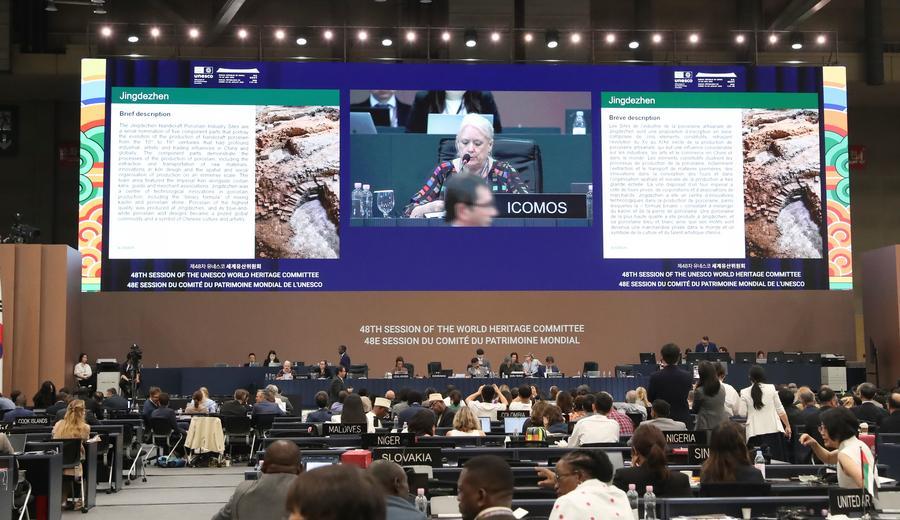
This photo taken on July 25, 2026 shows a scene during the 48th session of the World Heritage Committee in Busan, South Korea. The United Nations Educational, Scientific and Cultural Organization (UNESCO) added China’s Jingdezhen Handicraft Porcelain Industry Sites to the World Heritage List on Saturday during the 48th session of the World Heritage Committee held in Busan, South Korea. The inscription brings the total number of World Heritage sites in China to 61. (Xinhua/Yao Qilin)
Jingdezhen, China’s “porcelain capital” where kiln fires have blazed for over 2,000 years, has once again drawn the world’s gaze with its story etched in fire, clay and endless creativity of the human hand.
The United Nations Educational, Scientific and Cultural Organization (UNESCO) added China’s Jingdezhen Handicraft Porcelain Industry Sites to the World Heritage List on Saturday during the 48th session of the World Heritage Committee held in Busan, the Republic of Korea.
The inscription brings the total number of World Heritage sites in China to 61.
It marks the first time that China has nominated an industrial heritage site for World Heritage status, and it is also the first World Heritage site themed around porcelain.
Situated in east China’s Jiangxi Province, Jingdezhen Handicraft Porcelain Industry Sites are a group of heritage sites representing the handicraft porcelain industry system that developed in Jingdezhen from the 10th to the 19th century.
According to the World Heritage Committee, the property exhibits the innovative development of China’s handicraft porcelain making technology, porcelain art and porcelain industry, and evidences the profound impact of China’s handicraft porcelain industry on the development of the world’s ceramic industry and the exchanges and mutual learning among civilizations.
PORCELAIN-MAKING HISTORY CONNECTING WORLD
At a kiln site within the Taoyangli Historical and Cultural Block in Jingdezhen, dozens of ancient kilns in diverse forms, together with porcelain dating from the Song Dynasty (960-1279) to the Qing Dynasty (1644-1911), offer visitors from around the world a glimpse of the city’s continuous millennium-long history of porcelain craftsmanship.
This unbroken ceramic culture exemplifies the continuity of the Chinese civilization, said Weng Yanjun, head of the Jingdezhen Imperial Kiln Institute.
Located in a hilly area in northeastern Jiangxi, Jingdezhen is endowed with abundant reserves of kaolin, also known as China clay, and other raw materials essential for porcelain production. The city also enjoys convenient waterway access, as the Changjiang River flows through it and links Jingdezhen to Poyang Lake, the country’s largest freshwater lake, and further to the Yangtze River, China’s longest waterway.
More than 700 years ago, artisans in Jingdezhen pioneered a formula that mixed kaolin with other raw materials in specific proportions, enabling porcelain clay to withstand temperatures exceeding 1,300 degrees Celsius without deformation. Rather than guarding their techniques as secrets, they chose to actively spread the porcelain-making skills.
From porcelain found in the Tang Dynasty-era (618-907) Black Stone shipwreck and the widely traded Kraak porcelain, a Chinese ceramic product smuggled by a Portuguese merchant ship during the Ming Dynasty (1368-1644), to later Qing Dynasty pieces customized for European markets including armorial porcelain, shaving plates and duck-shaped vessels, Jingdezhen porcelain has traveled abroad for more than 1,000 years, reaching Asia, Africa, Europe and the Americas.
“We should cherish and protect ceramic sites where traditional ceramics have been produced during and throughout centuries. We can ensure that ceramics continue to connect people, preserve traditions and inspire future generations,” said Patty Wouters, International Academy of Ceramics representative to UNESCO.
The long history of porcelain production at Jingdezhen spans significant stages in human history, particularly the pre-industrial globalization of the trade in porcelain, according to the International Council on Monuments and Sites (ICOMOS).
EARLIEST INDUSTRIAL CITY
The late British scholar Joseph Needham referred to Jingdezhen as the earliest industrial city in the world. Archaeological findings have also shown that the city’s street layout was fundamentally shaped by its industrial specialization, where production sites, commercial establishments and dwelling quarters were closely integrated.
By the mid-Ming Dynasty, between 1436 and 1572, the city’s population had surpassed 100,000, far exceeding that of many contemporary European cities.
The specialized industrial framework, combined with other favorable conditions, has enabled Jingdezhen porcelain to exert a lasting influence across the globe.
In his “The Pilgrim Art: Cultures of Porcelain in World History,” American scholar Robert Finlay wrote that in the three centuries following the 16th century, 300 million pieces of Chinese porcelain, mostly produced in Jingdezhen, landed in Europe.
Jingdezhen porcelain, as a globally traded high-end commodity, has influenced the realms of painting, furniture, architecture and decorative arts in Europe, and has also served as a vehicle for the expression of the Chinese civilization and cultural globalization, said Huang Chunmao, a professor at the Central Academy of Fine Arts.
Today, Jingdezhen’s ceramic industry chain employs over 100,000 people, and the comprehensive division-of-labor system that once underpinned its historic success continues to thrive.
ICOMOS recognizes that Jingdezhen is credited with new kiln designs and decorative techniques such as blue-and-white and famille-rose porcelain, enriching the forms and styles of porcelain worldwide. The large-scale layout, specialized division of labor and standardized production created an efficient system, making Jingdezhen a leading example of industrial organization in the handicraft era.
VIBRANT PORCELAIN CAPITAL
Karima Duchamp, a French visual artist, has made three trips to Jingdezhen. Last year, she was stumped by the technical challenge of firing her paintings onto clay. But after observing a local artisan feed a several-meter-long clay piece into a kiln with seamless precision and no breakage, she believed her creative hurdle had been overcome.
The skill of Jingdezhen’s artisans, she said, was what made her artistic vision a reality.
Today, as a still-thriving “porcelain capital,” Jingdezhen is home to more than 3,200 inheritors of intangible cultural heritage in ceramic craftsmanship. It has also been inscribed in the UNESCO Creative Cities Network as a City of Crafts and Folk Art.
Inheritance is everywhere and innovation is ubiquitous in Jingdezhen, said Oriol Calvo Vergés, president of the Geneva-based International Academy of Ceramics.
In recent decades, China has demonstrated to the world that ceramics are far more than a heritage to be preserved. Notably, they can also serve as a powerful engine for urban renewal, education, tourism, innovation, artistic creation and international dialogue, Vergés added.
Tradition and innovation in Jingdezhen are not contradictory but complementary, and the city’s thousand-year resilience lies exactly in its capacity for constant self-renewal, observed 83-year-old Japanese ceramic artist Takeshi Yasuda.
“The World Heritage inscription marks a new starting point,” said Chen Kelong, Party chief of Jingdezhen.
“We will remain steadfast in our cultural confidence, safeguard the gems of ceramic culture, propel the ceramic industry with innovation and creativity, and build a new platform for cultural exchanges, ushering in a new chapter for ceramic culture in the new era,” he said. Enditem
Source: Xinhua